It's too early to know if Cade's more strict, says former counselor
For former advisor Ana Frazão, Brazilian capitalism is of compadrio and proximity between state and private sector facilitates corruption
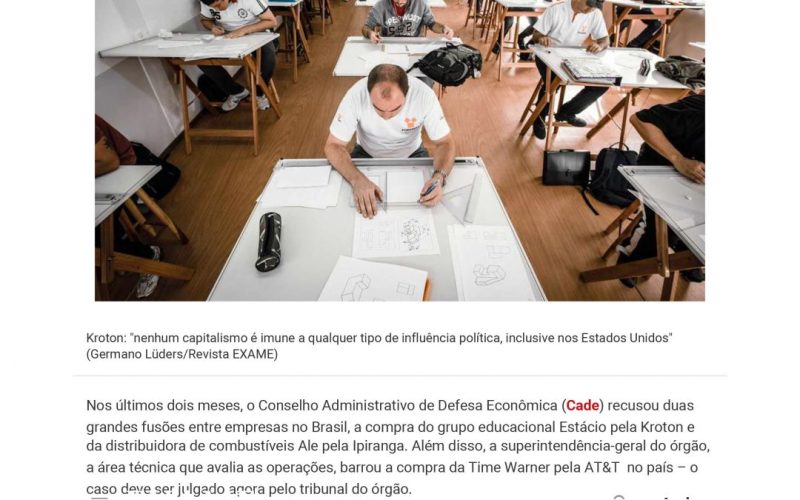
Kroton: "No capitalism is immune to any kind of political influence, including in the United States" (German Lüders/ExAME Review) In the last two months, the Administrative Council for Economic Defense (Cade) refused two major mergers between companies in Brazil, the purchase of the educational group Estacio by Kroton and the fuel distributor Ale for Ipiranga. In addition, the body’s general oversight, the technical area that evaluates operations, barred the purchase of Time Warner by AT&T in the country – the case must now be judged by the court of the body. Recent movements have led lawyers working with a corporate right to see a change of posture in the municipality. To know if that's a consummated fact, TEST talked to jurist Ana Frazon, former organ advisor and that this week released the book Competition Law - Presupposition and Perspective. Anna agrees that reprobations are rare, but she says it's too early to know if this is a trend in Cade. On this subject, competition and influence of corruption in business, she granted the following interview.
Recently, Cade has made tougher decisions regarding major mergers, as was the case with Kroton and the Stage and Ipiranga with Ale. Is that a trend? It's too early to make sense. We are talking about two operations that are, say, delicate in sectors where there were already a relatively large number of these operations. Of course it's an important sign. In fact, reprobations are rare, usually there is an attempt to negotiate. But it's still early, considering the peculiarities Cade has to make sense. Cade's current president, Alexandre Barreto, said in an interview with EXAME that decisions mean a maturity in jurisprudence. What happens in these cases, as I said, are markets that were already consolidated, which had already been through a number of previous operations.
The fact that Cade was quoted in Joesley Batista's report as having been specifically influenced by a decision by former deputy Rodrigo Rocha Loures may have to do with this change of posture? Nope. From everything I know about Cade, I can tell you for sure nothing happened. First, there was a mere call between authorities. Cade always had the policy of listening to everyone who was interested. Surely this has not altered at all any process that is there. Neither that particular nor others. Of course, a question like this puts the municipality in a position of visibility, but Cade always had this kind of visibility by judging complex causes and yet he never let himself influence or pressure himself. This type of question in the window is part of the practice and daily life of the municipality.
Can the political-economic moment influence decisions of the municipality? Not the political moment. Cade has been building a history of political independence since 1994. Of course it does not mean that he is totally indifferent to economic-political issues, because he judges in the context of a real country with all the problems. The crisis is taken into account in the analyses. Sometimes certain policies have a direct influence on the market and are taken into account. But the body is mature enough to be influenced by political issues. Economic policies change business scenarios, but I advocate that Cade should not be held hostage because the policies that have to suit the market, the market cannot be held hostage to the policy of one government or the other, especially in cases where they do not conform to the law.
Has the change in competition law in 2012 contributed to changes in Cade? Competition regulation is an important aspect, but it is not the only one. I've always argued that the anti-trust system and anti-corruption need to go together. Corruption is a way of achieving advantages that do not derive from its merit, competition is the opposite. In this sense, the more we ensure a competitive environment, the more we help in combating corruption. The law is important because it consolidates efforts that have come since the law of 1994 and monitors the system in various ways. One of them is the control of the structure of the companies in the process of merger, which became prior. Before things happened before Cade's decision was made. After the operation was completed, it was much harder to say no because of the economic upheaval that could generate. Can you imagine saying no to any of these recent cases after the companies were already one?
Do you think that Brazilian capitalism, even by its historical origin, is of compadrio? What could change that? I have no doubt that he is of compadrio. Now, it is important to mention that I start from the premise that no capitalism is immune to any kind of political influence, even in the United States this happens to a certain extent. The lobby discussion there is very current and helps to show that in any country, if there is no proper care, economic influence ends up permeating political power so that it gives the facilities to those interested. If this is true for everyone, it is even more true for Brazil. Often economic agents do not want to take the risk that is inherent to capitalism and end up seeing in the state a protector, an incentive, and press for these facilities. We have a very weak market and so a bank like the strong BNDES shows how capitalism depends on the state. And that leads to other problems. The greater the relationship between state and private market, the greater the possibilities of corruption, which is what we are seeing. Now, that is true for the great economic agents and there is the exception for the minors. I assume that the small and medium-sized businessman, who are true heroes in the country, could be better watched.
How do we reduce this proximity and, consequently, try to hinder corruption? Of course it involves a political issue, but there are several legal instruments. Firstly, lobbying control and regulation is essential. Total transparency of relations between public and private actors. Control of who public agents receive and when this happens, what additional remuneration these agents can receive from private entities, etc. Nothing like transparency to mitigate corruption.
But in the United States a regulation for the lobby considered too harsh ended up taking some lobbyists into the shadows again, some have ceased to register as such, and so it has even been seen as a setback. Don't we take that risk? This lobbyist may no longer register, but if the authority has an obligation to tell us who met, whether registered or not, we will know about it. Regulations create these obligations for authority. Of course they'll be able to take it. You will be able to create another moment for this discussion, during an informal dinner or playing golf, as happens there. But then civil society has to try to monitor it somehow. Because if we do, this is a problem in a certain way insoluble. It is difficult to imagine any change if people are not willing to comply, but with an adequate structure for agents to stick their work by ethics, we take a big step in this direction, even without being assured of absolute effectiveness.
The economic team has been working on a new law of judicial recovery. Why is this important to the country’s business environment? Porque a ideia hoje é de que a empresa não diz respeito apenas aos interesses do empresário. Há uma série de interesses de consumidores, trabalhadores, fornecedores. A ideia é ter um sistema adequado para possibilitar a recuperação das empresas sem prejudicar essas outras partes. A falência deve ser o último recurso. Porém, após alguns anos da nossa lei atual, vimos que algumas soluções não são tão adequadas como pareciam ser. Empresas que não deveriam obter recuperação acabam tendo, o que tem efeitos nocivos para a economia. Já podemos medir o que deu certo e o que não.
Inclusive simplificando a retirada de empresários da operação de empresas em recuperação? A própria lei já possibilita a sucessão em uma série de circunstâncias. Certamente a discussão sobre a alienação de controle acaba acontecendo parcialmente nesses casos de estabelecimentos, ou entes produtivos, ou pode acontecer na própria circunstância na decretação de falência.
Mas a lógica fora do Brasil é que se retire os empresários e aqui está funcionando um pouco diferente. Somos mais complacentes? Tenho defendido que em casos de corrupção, por exemplo, haja alienação. Há um impasse quando o dano é muito alto e a empresa vai quebrar. Mas se o controlador dessa empresa ficar, ele vai ser beneficiado de uma multa menor para não quebrar a empresa que ele deixou nessa situação. Deveria haver uma alienação do controle para que esse controlador que agiu de forma errada não tenha nenhum benefício. Temos que ter algum ponto para não salvar o controlador, mas temos que manter a empresa. Não é que seja uma questão simples, mas em situações extraordinárias, tem de ser pensadas alternativas para que as empresas sejam mantidas com outro controlador.