


Category: Press
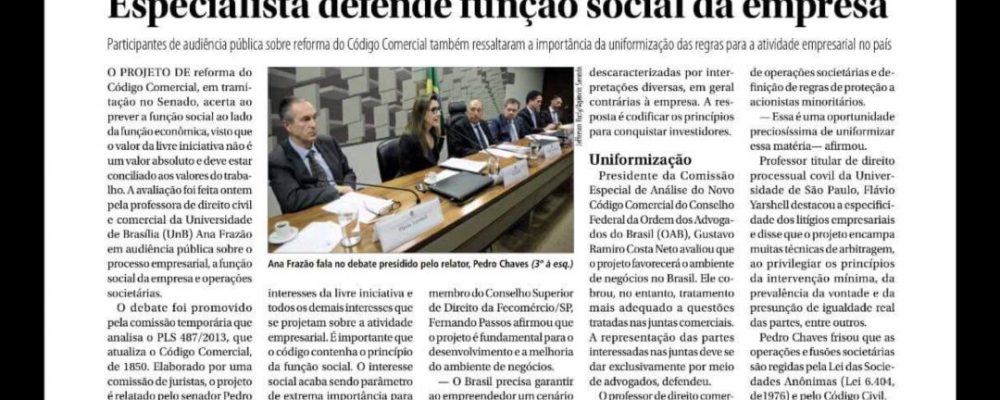
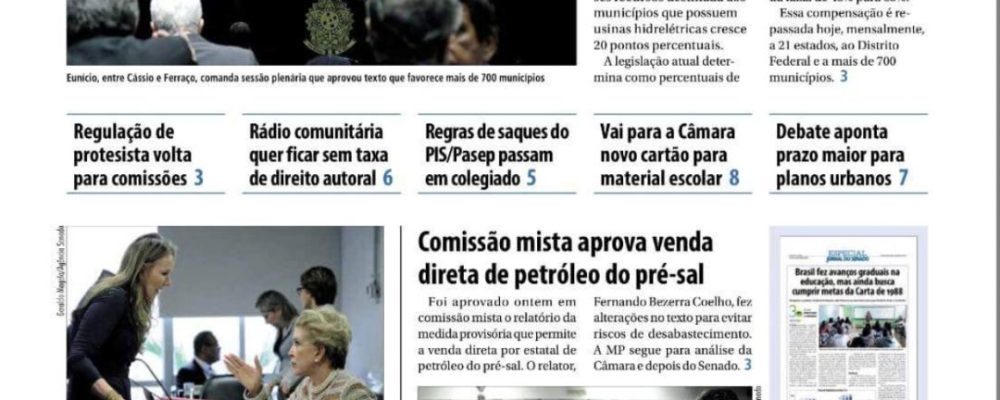
Senate Journal 12/04/2018

Article JOT (09/08/2017) Digital platforms and competitive repercussions
Is collective negotiation possible in front of Internet giants?
Available: https://www.jota.info/opiniao-e-analysis/columns/company-and-market/digital-and-repercussion-competitive-platforms-09082017
Digital platforms and competitive repercussions
Is collective negotiation possible in front of Internet giants?
Recently, the News Media Alliance (NMA) announced its determination to plead with the US Congress[1], antitrust exemption to be able to negotiate collectively, on behalf of journalistic vehicles, with Facebook and Google. As it is known, both electronic platforms, in addition to walking to a duopoly in the digital advertising market, present themselves today as true channels of distribution of journalistic content[2].
The issue rekindles a stormy debate on Competition Law, which concerns the possibility and limits of collective bargaining and how to differentiate such hypotheses from the closed cartel practice. It is worth remembering that, just in the initial period of Sherman Act, edited in 1890, the concern with collective negotiations was such that even the negotiations brokered by workers' unions were considered illegal, making it necessary for the US Congress to exempt them from the sanctions of that law.
It is curious, at the very least, the historical difficulty of accepting that collective negotiations may be, in certain cases, lawful and even necessary. Indeed, the very reason for Competition Law is the recognition that there is no perfect competition and that certain players, holders of a dominant position, influence the market as a whole and can subjugate, in addition to consumers and other competitors, also other contractors. Thus, it would be natural for those who hire with such agents in an evident situation of asymmetry and fragility to join together at least to neutralize the exaggerated power of the other pole, obtaining a minimally fair negotiation. It is what is called compensatory power, i.e. the union of the weaker parties to counterbalance the power of the stronger part.
[formula fulllist]
However, such a position was never properly accepted. The same Competition Law, which, since its inception, is accused of being overly tolerant with the approval of mergers, proved insensitive to the argument that the weaker parties of a negotiation should be able to unite in order to contain the excesses possibly committed by holders of dominant positions, obtaining minimally fair conditions.
Otherwise, as Galbraith explains[3], the traditionally accepted position has always been to restrict the use of compensatory power. According to the author, the consequences of the ignorance of compensatory power were particularly serious for the structure of the US industry, as it led the antitrust authority to strengthen precisely the positions it should attack, to the detriment of free competition. It should be noted that compensatory power is exercised in order to produce a structure – whether in the form of trade unions, associations, or other associations – that can be at least opposed to the economic power held by the other part of the negotiation, empowering the weaker contractor to give him greater bargaining power and thus mitigate the inequality of negotiation, without obviously inverting the asymmetry relationship[4].
An example of the Brazilian discussion on the subject can be seen in the CADE jurisprudence, which does not accept the thesis of compensatory power even in the hypothesis of tables on medical fees, although it recognizes the evident asymmetry of doctors in negotiations with health operators[5].
It is clear that such thinking can generate inconsistencies in antitrust control, starting with the fact that a posture refractory to any type of collective negotiation usually has the effect, albeit indirect and unintentional, of favoring the dominant parties. On the other hand, collective bargaining can be a much more efficient mechanism for neutralising the dominant position than direct legislative intervention in contracts, since contractual dirigism, in addition to its shortcomings, can be especially harmful in some types of complex contracts, which, because they cannot be aprioristically grasped by the legislator, should be the subject of negotiations between the parties.
That is why the NMA initiative comes in good time to bring up again the issue of collective negotiations and the exercise of compensatory power, especially in a case where there are good grounds to believe in the asymmetry between Google and Facebook, on the one hand, and traditional media, on the other. In fact, they have on Google and Facebook one of the main – if not the main – distribution channels, depending considerably on them for the maintenance of their activities and for the guarantee that their contents reach several users[6].
As already pointed out in the previous article[7], electronic platforms have revolutionized various aspects of business activity and enabling new forms of collective arrangements and negotiations that have impacts on competition law. Consider the case of Uber, which negotiates collectively on behalf of taxi drivers, who are themselves considered as self-employed and non-employed carriers. This aspect is interesting to show that in many cases it is the platform that holds a dominant position that organizes collective bargaining, without the antitrust authorities having seen, at least until now, effective problems in this conduct.
The peculiarity of the hypothesis presented by the NMA is that now the discussion is whether those who negotiate with the platforms in a position of dependence or asymmetry can also unite in favor of the exercise of compensatory power and, if so, what would be the limits of collective negotiation for this purpose. From there, there is controversy that can extend to several electronic platforms. Taking the example of Uber, an interesting question would be whether drivers could also collectively negotiate their remuneration and working conditions to neutralize the dominant position of the platform.
For now, given the restrictions and difficulties for accepting the argument of compensatory power, the NMA example can be confined to the legislative harvest, without becoming a precedent. However, the increasing power of electronic platforms is an excellent pretext to enable antitrust authorities to reflect more carefully on the possibility of making compensatory power possible by other contractors, although with due and necessary limits.
———————————–
[1] RUTENBERG, Jim. News outlets to seek bargaining rights against Google and Facebook.The New York Times. 9 Jul. 2017. 14 Mar. 2017. Available at: Accessed: 07.08.2017.
[2] According to the portal andMarketer, Facebook and Google companies move towards the domination of 60% of the digital advertising market, crushing relevant competitors like Snapchat. View: Google, Facebook increase their grip on digital ad market: eMarketer’s latest estimates show balance tipping. eMarketer. Disponível em: <https://www.emarketer.com/Article/Google-Facebook-Increase-Their-Grip-on-Digital-Ad-Market/1015417> Acesso em: 07.08.2017.
[3] GALBRAITH, John Kenneth. American Capitalism: the concept of compensatory power. São Paulo: New Century, 2008. p. 117.
[4] FRAZON, ANNA. Competition law: assumptions and prospects. São Paulo: Saraiva, 2017. p. 362.
[5] CADE, Administrative Process No. 08012,007042/2001-33, Rel. Advisor Roberto Augusto
Castellanos Pfeiffer, Date of trial: 30.08.2006; CADE, Administrative Process No. 08012,004276/2004-71, Rel. Counsellor Ana Frazão, Date of trial: 29.10.2014.
[6] It is noteworthy that the issue of asymmetry in this hypothesis is controversial. See, on the subject, JULIO, Karina. Vehicles tighten trading with platforms. & Message medium. 14 jul. 2017. Disponível em: <http://www.meioemensagem.com.br/home/midia/2017/07/14/veiculos-reivindicam-negociacao-com-plataformas.html> Acesso em: 07.08.2017.
[7] FRAZON, ANNA. Antitrust dilemma: Does Uber form a cartel of drivers? Jota. 12 dez. 2016. Disponível em: <https://jota.info/concorrencia/dilema-antitruste-o-uber-forma-um-cartel-de-motoristas-12122016> Acesso em: 07.08.2017.

JOTA às CLARAS (05/10/2017) – Lobby without limit mine idea of democracy, says Ana Frazão
According to UNB's teacher, regulating practice is based onl
Available:
https://www.jota.info/special/as-claras/lobby-no-limit-mina-idea-de-democracy-diz-ana-frazao-05102017

JUSTICE LIVE PROGRAMME – TV JUSTICE (04/12/2017) – Interview on the contributions of lawyer Ana Frazão to Business and Competition Law
Available:
https://www.youtube.com/watch?v=6jl2ZEWrX4&feature=youutu.be
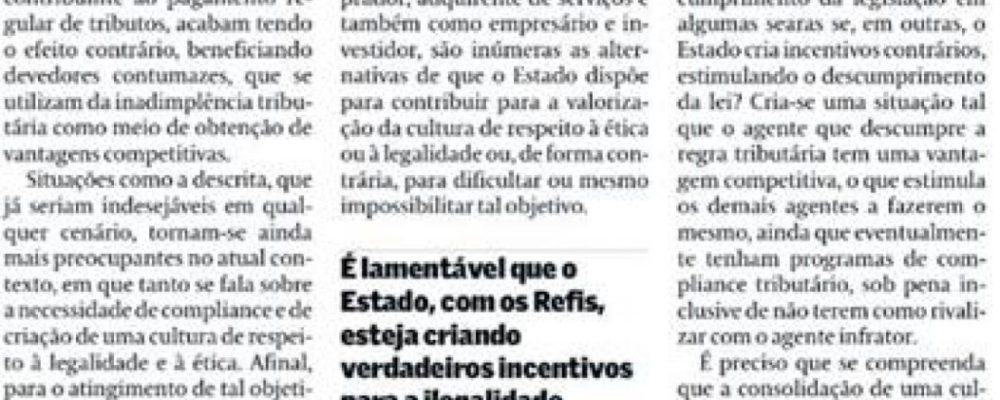
ECONOMIC VALUE (29/12/2017) The role of the State in the face of compliance programs, by Ana Frazão
Available: http://www.valor.com.br/opiniao/5240679/o-paper-of-the-state-of-the-complicity programmes
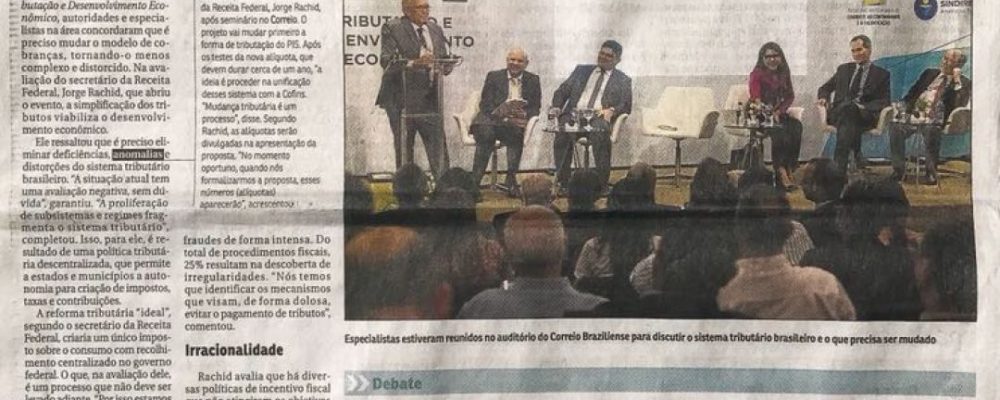
CORREIO BRAZILIENSE (03/07/2018) – To grow, Brazil needs to simplify taxation
Ana Frazão, lawyer and professor of Civil Law at the University of Brasília (UnB), argues that it is necessary to end tax privileges, given to certain sectors of the economy, because this generates an unequal system and contributes to the concentration of income. In addition, the expert argues that the State is the first to comply with the legislation, which has not been doing, contributing to the practice of evasion. Ana Frazão criticized the Special Tax Regulatory Program (Pert), better known as Refis, which was approved at the National Congress in 2017, giving discounts of up to 90% and portioning companies' debts. The text of the provisional measure (MP) benefited the irregular companies. "I imagine an entrepreneur even correct, who pays the taxes properly, feeling obligated not to pay (taxes) to keep himself on the market. Yeah, how are you gonna run with someone who's not subject to the same tax burden?", he asked.

CORREIO BRAZILIENSE (06/03/2018) – Distortions in the economy are encouraged by the state, says Ana Frazão
Available:
http://www.correiobraziliense.com.br/app/noticia/economy/2018/03/06/interns economy,664140/distortions-in-economy-tambi-e-encouraged-by-state-defend-ana-f.shtml

Bread
Available at: http://www.migalhas.com.br/files/2017/11/art20171122-16.jpg
Legal Adviser
Available at: https://www.conjur.com.br/2017-Dec-04/experts-analyze-legal-state-book