

O evento ocorreu nos dias 30/10 e 01/11, com inúmeras palestras dos mais renomados comercialistas. Ana Frazão abordou a temática dos contratos híbridos e a nova economia.
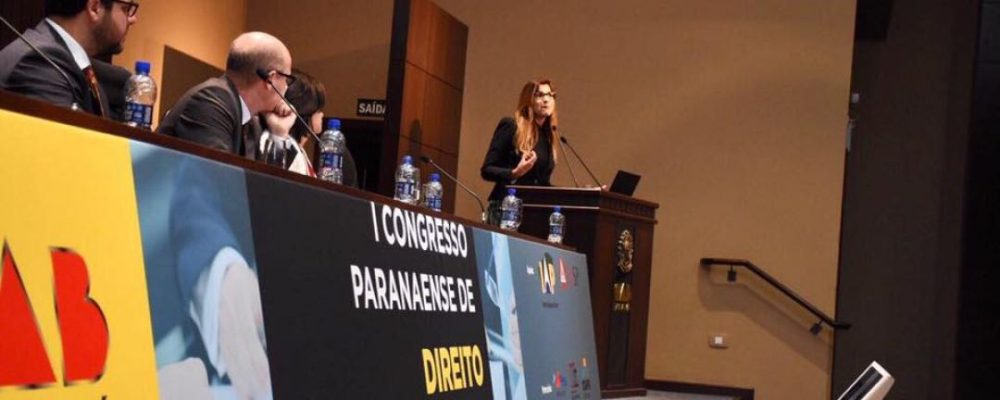

O evento ocorreu nos dias 30/10 e 01/11, com inúmeras palestras dos mais renomados comercialistas. Ana Frazão abordou a temática dos contratos híbridos e a nova economia.
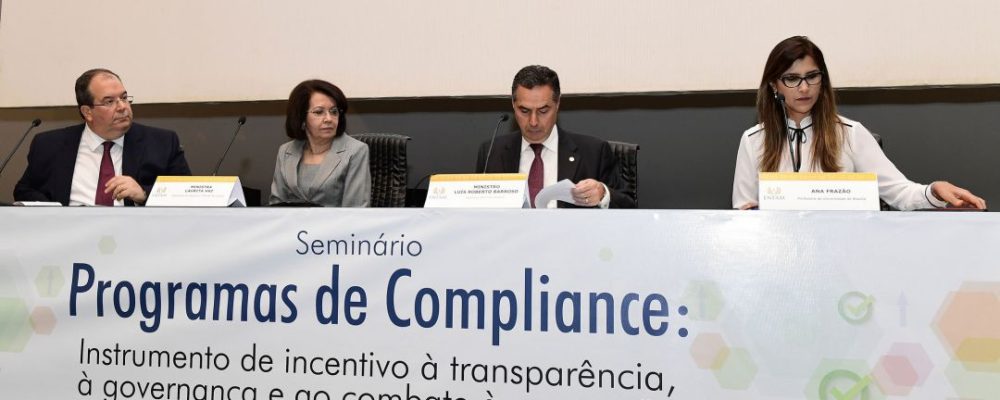
"Although photography is ugly, the film is good," said Minister Roberto Barroso of the Supreme Court (STF), referring to the Brazilian political scenario. The phrase was said in the inaugural lecture of the seminar Compliance Programs: Instrument to encourage transparency, governance and the fight against corruption.
The event, which is promoted by the National School of Training and Improvement of Magistrates (Enfam), in partnership with the Superior Court of Justice (STJ) and the Fundação Getúlio Vargas Projects (FGV Projects), takes place throughout Thursday (26) in the auditorium of the STJ, in Brasilia.
The aim of the seminar is to discuss integrity programs and the fight against corruption, as well as its importance in state governance. "The programs of compliance they are composed of routines and practices designed to prevent risks of corporate responsibility arising from non-compliance with legal or regulatory obligations in addition to traditional sanctioning policies, which are based on the implementation of a sentence corresponding to the illicit practice," explained Minister Villas Bôas Cueva, scientific coordinator of the event alongside Professor Ana Frazão, from the University of Brasília (UnB).
According to the minister, compliance they turn to a change of behavior through standards of conduct to be observed and monitored by companies, administrators and employees in order to avoid committing the illicit.
Transparency
"The theme is instigating, current and, above all, indispensable to the clean country," said Minister Laurita Vaz, president of the STJ, during the opening ceremony. According to her, both in the corporate and financial markets, the implementation of compliance, as a strategic management tool, help fight corruption, in addition to improving governance and ensuring transparency, which "provides a solid basis for economic development".
For Minister Luis Felipe Solomon, who participated as president of the first panel, the event will enable a reflection on postures in the public and private field, old and current practices: "A real tank of ideas, a real proposal plant, which I am sure will be a milestone in this theme and in this special moment that Brazilian society lives."
Negative photograph
Minister Barroso’s inaugural talk was the theme Democracy, corruption and justice. In describing the current scenario of Brazilian politics, he recognized that, in a first analysis, "photography is negatively impressive".
"A president of the Republic who was twice denounced by the Attorney General of the Republic, one for passive corruption and the other for obstruction of justice. There's a former president of the Republic convicted in the first degree. There is another former president of the Republic already denounced before the Supreme Court for passive corruption; two former heads of the Civil House have already been convicted, one in the first degree and the other in the second degree, for active corruption and the other for passive corruption; a former head of the government secretariat of the presidency of the Republic is arrested preventively because supposedly it would have been found in his apartment the bagatela de R$ 50 million; two former mayors of the House of Representatives are currently under arrest; several state governors are currently responding to criminal proceedings, some prisoners. All the advisers of the Court of Auditors of a state, except one, were arrested preventively by determination of the STJ; the award-winning denunciation of Odebrecht made mention of 415 politicians from 26 parties, the award-winning collaboration of JBS involved 1,829 politicians from 28 parties. This is the photograph of the current Brazilian moment, without any value judgment," the minister said.
"An amazing episode of widespread corruption," Barroso acknowledged. However, for the minister, "film is good" because society has reacted and the country is experiencing a moment of change in attitude, changes in legislation and jurisprudence that, although slow, are progressive.
Point to point
" I think that the change in attitude begins with Criminal Action 470, known as Monthly, when, pushed by society, the Supreme Court for the first time in the history of Brazil, this is the harsh truth, punished a relevant set of people for crimes such as active corruption, passive corruption, embezzlement, money laundering, fraudulent management of financial distribution. There was an emblematic mark of change of attitude," the minister said.
Regarding the change in legislation, Barroso cited the promulgation of the law on crimes against the financial system and against the tax order, the worsening of the penalty for active and passive corruption, the money laundering law, the law defining criminal organizations, the anti-corruption law and the clean record law.
In the case-law, Barroso cited as the most important change in dealing with corruption the recognition by the Supreme Court that it is possible to execute condemnatory decisions after the second degree trial.
" It was the most important measure that was taken in Brazil, because the previous requirement of the transit on trial was that it made it impossible to execute any penalty for white collar crime. With procrastinal resources it was postponed in ten, 12, 15, 25 years the execution of decisions, until the prescription," he explained.
For him, "the seed has already been planted, hearts and minds have already been conquered", but "who was waiting for the knockout will not watch, because the fight is point to point".
Other debates
During the day, discussions are still planned on programs to combat corruption, state governance, as well as debates on the view of the academia and the market on compliance.
STJ SOURCE
Far from being an unjustified privilege granted to business companies, the limitation of the responsibility of the partners is an important instrument to stimulate productive investment. In fact, the perfect patrimonial separation resulting from it makes only the property of the personified society – and no longer the personal assets of the partners – answer ordinarily for the debts of the society.
By means of limited liability, the partial socialisation of the business risk is ensured, in that, in the face of the company’s patrimonial insufficiency, it will be creditors – and no longer members of limited liability – who will bear the losses. It is based on the premise that, being in everyone's interest the promotion of productive investment, it is fair and reasonable that the community as a whole can afford part of the business risk[1], ensuring aspects that are fundamental to business activity, such as legal certainty, predictability and risk calculation.
However, there are also many possibilities that the perfect patrimonial separation between society and its partners can be abused, transforming an instrument of partial socialization of business risk into an instrument of total transfer of business risk to social creditors.
This problem is especially aggravated in countries that, like Brazil, allow the use of the model of society limited by small enterprises, of a strong personal or family character – in relation to which it is difficult to have a social interest distinct from the personal and concrete interest of the partners – and still without any care regarding the formation of social capital, a value that corresponds to the contribution of the partners to the project and, in this sense, delimits the measure of the risk they are willing to take.
In fact, it is a recurrent practice in Brazilian corporate law that there are manifestly low or inconsistent social capital values with the risk to be assumed, so that, in the face of situations of asset insufficiency, the partners will be in the comfortable position of stealing responsibility for the undertaking without having ever effectively assumed a reasonable part of the risk. Hence the subcapitalisation problems[2], given that, in the face of low values, the function of share capital is completely subverted.
However, as much as it is known that social capital is not confused with social equity – this, yes, the real guarantee of creditors – it is a fact that equity insufficiency is often the result of the derisory value of social capital, a situation in which the partners do not assume the risk of the business, transferring it exclusively to the creditors of the company.
The problem increases when one realizes that the limitation of responsibility has serious consequences especially for small creditors and involuntary creditors, seen the latter as those who have never negotiated properly with society, but are creditors of it due to unlawful acts committed by it from which they were harmed.[3].
On the other hand, it is known that the big creditors, in practice, end up being protected by an "unlimited" liability, in that they have the power to bargain to surround themselves with guarantees other than the assets of society (including personal and real by the partners) or at least to consider the risk assumed for the purpose of obtaining greater advantages in the negotiations.
It is not without reason that the assumption of the economic analysis of the right that limited liability is a factor for reducing transaction costs is based on the premise that those who negotiate with a limited liability company are able to demand additional advantages as a counterpart to the higher risk they take. It does not take much deepening to realize that such reasoning only applies to creditors with bargaining power, which obviously drives away small creditors and so-called involuntary creditors.
O cenário descrito mostra que estamos diante de um problema verdadeiramente estrutural do direito societário brasileiro, que possibilita muitas injustiças e distorções. E, para resolver o problema, a única solução que tem sido utilizada é a desconsideração da personalidade jurídica.
Ocorre que, inicialmente confinada às hipóteses de abuso da personalidade jurídica, tal como prevê o artigo 50 do Código Civil, a desconsideração passou a ser gradativamente utilizada, em diversas hipóteses, apenas diante da insuficiência patrimonial, sendo dispensável o abuso.
De fato, a chamada “teoria menor”[4] é hoje a regra em muitas searas, tais como Direito do Consumidor, Direito do Trabalho e Direito Ambiental, dentre outras. Contudo, tal teoria, na prática, importa a negação da separação patrimonial perfeita. Por mais que se esteja diante de pequenos credores ou credores involuntários, a aplicação linear da teoria menor tem efeitos perversos, principalmente em casos em que os sócios se utilizaram adequadamente da responsabilidade limitada e assumiram a sua parte do risco empresarial.
Da mesma forma, pode haver muitas distorções quando a chamada teoria maior, que requer a comprovação do abuso, é utilizada de forma indiscriminada e sem a comprovação do desvio de finalidade que deve justificar a responsabilização dos sócios e administradores.
A situação torna-se ainda mais grave quando se percebe inexistir, no direito brasileiro, uma reflexão mais séria a respeito da eficácia subjetiva da desconsideração da personalidade jurídica que, pelo menos nos casos de aplicação da teoria maior, deveria recair preferencialmente sobre os sócios e administradores envolvidos com o desvio de finalidade. Entretanto, o STJ já decidiu que a desconsideração deve abranger indistintamente todos os sócios[5].
A utilização indiscriminada da desconsideração da personalidade jurídica rompe, portanto, não apenas com os pressupostos de segurança e calculabilidade do risco, como até mesmo com os pressupostos de justiça que, na verdade, são aqueles que mais justificam a sua utilização. Por mais que a banalização da desconsideração seja reflexo da banalização da responsabilidade limitada, nem sempre se observa que o remédio, a depender da dosagem, pode se transformar em veneno.
A partir do momento em que a desconsideração passa a ser a regra, a personalidade jurídica perde, nas sociedades com sócios de responsabilidade limitada, o seu efeito de separação patrimonial perfeita, o que desestimula ou impossibilita o investimento e ainda gera altos custos de transação, os quais serão certamente repassados para o preço final de produtos e serviços. Não é sem razão que alguns já advogam o fim da responsabilidade limitada no Brasil[6].
Chegamos, portanto, ao pior dos mundos: um mundo em que a personalidade jurídica e a responsabilidade limitada nem mais garantem segurança nem justiça. E, sem nenhuma iniciativa séria para resolver estruturalmente o problema, continuamos sem esperança de solução.
———————————————–
[1] FRAZON, ANNA. Função social da empresa: repercussões sobre a responsabilidade civil de controladores e administradores de S/As. Rio de Janeiro: Renovar, 2011. p. 18.
[2] Ver, nesse sentido: DINIZ, Gustavo Saad. Subcapitalização societária: financiamento e responsabilidade. Belo Horizonte: Fórum, 2012.
[3] FRAZÃO, Op. cit., pp. 389-391.
[4] A norma do diploma de 2002 corresponde ao que Fábio Ulhoa Coelho (Fábio Ulhoa Coelho, Curso de direito comercial. São Paulo: Saraiva, 2009. v. 2, p. 74) denominava por “teoria maior da desconsideração”, aplicável como meio de coibição de fraudes e abusos perpetrados por intermédio da pessoa jurídica, em contraponto à teoria menor, por meio da qual se afastaria a autonomia patrimonial da pessoa jurídica com o simples prejuízo do credor, distinção que o autor abandonou em razão da evolução do tema na jurisprudência.
[5] Trata-se de hipótese de aplicação da teoria maior, na qual se afirmou que “Para os efeitos da desconsideração da personalidade jurídica, não há fazer distinção entre os sócios da sociedade limitada. Sejam eles gerentes, administradores ou quotistas minoritários, todos serão alcançados pela referida desconsideração” (STJ, 4ª T., REsp 1.250.582/MG, Rel. Min. Luis Felipe Salomão, julg. 12.4.2016, publ. DJe 31.5.2016).
[6] SALAMA, Bruno. O fim da responsabilidade limitada no Brasil: história, direito e economia. São Paulo: Malheiros, 2014.
Ana Frazão –
Advogada. Professora de Direito Civil e Comercial da UnB. Ex-Conselheira do CADE.
Os artigos publicados pelo JOTA não refletem necessariamente a opinião do site. Os textos buscam estimular o debate sobre temas importantes para o País, sempre prestigiando a pluralidade de ideias.
Fonte Oficial: https://jota.info/columns/company-and-market/limited liability-18102017.
?Os textos, informações e opiniões publicados neste espaço são de total responsabilidade do(a) autor(a). Logo, não correspondem, necessariamente, ao ponto de vista do Portal do Magistrado.