



Category: All

Ana Frazão column on jota 25/06: Is self-employed better than having a job? Behavioral economy and the economy of narratives help us understand the reasons why the CLT seems to be down .

Ana Frazão column in the 18/06 Jota: Are social networks compromising market efficiency? The less efficient markets hypothesis sustained by Clifford Asness.

Open of Podcast Law and Economy with Ana Frazão of June 12: Trade union organization in Brazil, with Clemente Lucio.

Column of Ana Frazão no Jota de 11/06: Judgment on the constitutionality of article 19 of the MCI – Let us not invoke freedom of expression in vain.

Column of Ana Frazão in Jota 4/06: What is the legal regime applicable to digital goods? the case of air miles and restrictions at the disposal of the holders.
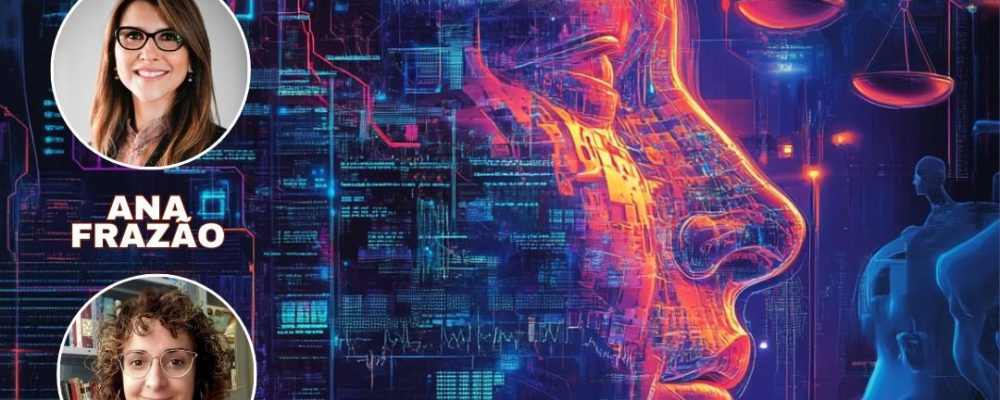
Opens the Podcast Digital Law with Ana Frazão and Caitlin Mulholland on June 4: Synthetic Data.
To listen just access the link: https://open.spotify.com/episode/3HS5OfFr4w4DYwQh1VzDy
We live an era driven by data. From business decisions to public policies, from personalized advertising to medical diagnoses, through facial recognition mechanisms, predictive analysis and recommendation systems, data are in everything. But what about when this data is not available? When are they incomplete, biased or simply impossible to access through legal, ethical or structural barriers? In this scenario, synthetic data is gaining more space as a solution — or, for some, as a new problem. But what are synthetic data?
Contrary to what the name may suggest, synthetic data is not "false data" in the vulgar sense of the word. They are artificially generated by algorithms that mimic the statistical properties of real data. The idea is that they reproduce expected patterns, correlations and behaviors, without revealing or exposing true information from individuals or organizations.
In practice, synthetic data is created from two main methods: the perturbation of real data with noise (technique that protects identity and confuses attempts to reidentify) and the completely autonomous generation of new data through generative models such as the GANs (Adversarial Generating Networks) — the same technology behind deepfakes and hyper-realistic images generated by AI.
This advance solves an old problem: the chronic scarcity of reliable data. As Professor Marcelo Finger of the University of São Paulo (USP) pointed out in a recent interview, even large laboratories such as OpenAI face limitations in this regard. "We live with the chronic lack of data, even with OpenAI," he said. In many sectors, such as health, finance or law, access to real data is surrounded by secrecy, high cost and regulatory complexity. The alternative? Create data that is true to reality, but that does not represent anyone in particular.
The adoption of this technology is growing. According to Gartner's report, by 2030, 60% of the data used to train AI models will be synthetic. And that's not science fiction. — today, companies such as Nvidia, Google, Meta and specialized startups like Synthetaic and Mostly AI invest heavily in this front. In the automotive industry, for example, synthetic data is used to simulate billions of kilometers run by autonomous vehicles without leaving the laboratory. In the area of health, they allow creating databases of fictitious patients who help train diagnostic algorithms without harming medical confidentiality.
There is an additional concern when these data feed systems with high decision-making autonomy, such as automated judicial systems, artificial intelligence in administrative decisions or banking risk analysis. In these contexts, the illusion of objectivity of synthetic data can be even more dangerous than the explicit bias of real data, precisely because it escapes the critical perception of operators.
Another sensitive point is the right to transparency. If AI makes decisions based on data that are not auditable, why are they synthetic, how will it be possible to perform social control, judicial reviews or technical expertise? This directly touches the heart of digital law: the balance between innovation and responsibility, between what is possible and what is acceptable
In universities, the use of synthetic data also expands. At PUC-Rio, for example, researchers have studied ways to apply this technology in public policy studies, while at UFRJ and FGV there are debates on the legal and ethical limits of data manipulation in the context of artificial intelligence.
In this episode we will deepen these debates. Let's understand how synthetic data is being used, what promises and dangers they bring, and how law can — and should — respond to this new frontier of artificial reality. Come with us!

Ana Frazão participates in the event The Supreme Court and Arbitration on June 6 at 11:00.

Ana Frazão participates in the event Contemporary Themes of Commercial Law on June 5 at 10:45.

Open of Podcast Law and Economy with Ana Frazão of 29/05: Challenges of Industry in Brazil, with João Carlos Ferraz.
In the episode, Ana Frazão talks with João Carlos Ferraz, Full Professor of the Institute of Economics of UFRJ, about the challenges of industry in Brazil. The teacher makes a diagnosis of the current scenario, trying to map the characteristics of the Brazilian industry, as well as the factors that influence the progressive loss of its importance in GDP. Among the subjects explored are the importance of industrial policies and the requirements for their design, as well as sustainability, both in terms of the challenges it presents, as well as opportunities.
To access the link: https://open.spotify.com/episode/0zmUF4eaiDyLvcOahuxsFH